
The Dubai Metro is the most convenient way to get around the city during the day: no traffic jams, a clear schedule and a transparent price. To plan a route quickly, you just need to understand the map: only two lines, two interchange hubs and seven fare zones. In this breakdown — how to read the Dubai Metro map, which stations are key, and where to download the official scheme. This is a companion piece to the full guide Dubai Metro — the complete guide.
How the Dubai Metro Map Is Structured
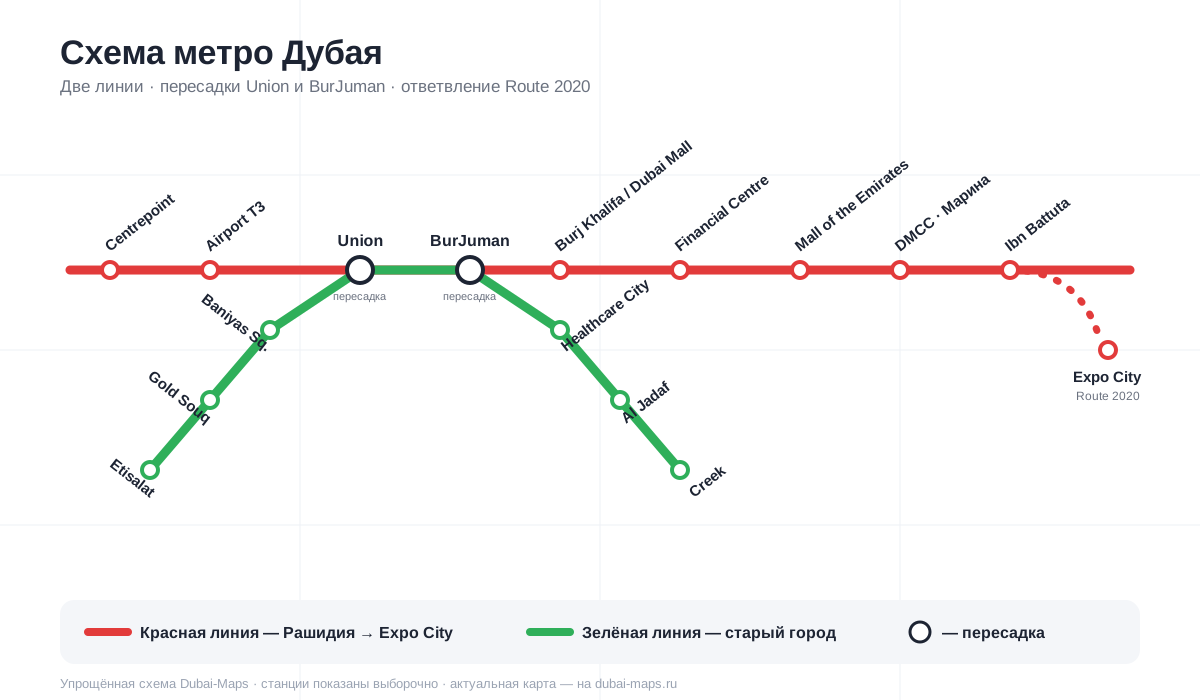
The Dubai Metro opened in 2009, it is run by the RTA transport authority, and the trains are fully driverless. The scheme is built simply and rests on two lines:
- Red Line — the city’s main artery, running along Sheikh Zayed Road from Rashidiya to Expo City.
- Green Line — a compact city line connecting the old districts of Deira and Bur Dubai.
- Route 2020 — a branch of the red line (5 stations), opened in 2021 and leading to Expo City.
The lines on the map are colored in their own colors, cross at only two points, and the stations are numbered and labeled in the Latin alphabet. So even without knowing Arabic, the Dubai Metro map reads intuitively.
The Red Line
The red line is the city’s “backbone.” It runs along the main highway, Sheikh Zayed Road, and connects the airport, the business district, Downtown, the Marina and the Expo City exhibition cluster. The route runs from Centrepoint station (Rashidiya) to Expo 2020 / Expo City via the Route 2020 branch.
| Station | What’s nearby |
|---|---|
| Airport Terminal 1 / Terminal 3 | DXB airport terminals |
| Union | Interchange to the green line, Deira |
| BurJuman | Interchange to the green line, BurJuman mall |
| Burj Khalifa / Dubai Mall | Burj Khalifa, Dubai Mall |
| Financial Centre | The DIFC business district |
| Mall of the Emirates | The mall and Ski Dubai |
| DMCC | Dubai Marina, connection to the tram |
| Ibn Battuta | A themed shopping mall |
| Energy | An industrial and office zone in the south |
| Expo 2020 / Expo City | The terminus of the Route 2020 branch |
After the table the takeaway is simple: the red line covers almost all the tourist spots — from the airport to the Marina and Expo City — so most of a visitor’s trips run along it.
The Green Line
The green line is shorter and serves the historic part of the city on both sides of Dubai Creek. It is handy for strolling around the markets of Deira and old Bur Dubai. The route runs from Etisalat station to Creek station.
| Station | What’s nearby |
|---|---|
| Gold Souq | The gold market of old Deira |
| Baniyas Square | Deira’s shopping district, abra docks |
| Union | Interchange to the red line |
| BurJuman | Interchange to the red line, Bur Dubai |
| Dubai Healthcare City | The medical cluster |
| Al Jadaf | The waterfront and cultural quarter |
| Creek | The terminus by Dubai Creek |
After the table it is clear that the green line is the route through “old Dubai”: markets, abra docks and the creek waterfront. For the historic districts it is more convenient than the red line.
Interchanges: Union and BurJuman
You can switch from the red line to the green (and vice versa) only at two stations:
- Union — a hub in Deira, closer to the old town and the markets.
- BurJuman — a hub in Bur Dubai, next to the mall of the same name.
On the map these stations are marked with an interchange icon and are located where the two colored lines meet. If your route requires changing lines, navigate by these — there are no other transfers.
Dubai Metro Zones
The city is divided into 7 fare zones, and the fare depends not on the number of stations but on how many zone boundaries you cross. On the zoned map the lines are overlaid on colored sectors — so you can immediately see whether you are staying within a single zone or moving into a neighboring one.
- A trip within a single zone is the cheapest.
- Each additional zone adds a fixed amount to the fare.
- The longest routes (for example, to Expo City) cross several zones and cost more.
Prices and calculations with examples are covered in detail in the article fares by zone. Travel is paid for with a transport card — to learn how to choose one, read the article the Nol card.
Where to Download the Official Map
The most reliable source is the operator RTA: it publishes the up-to-date metro map with all the lines and zones, which you can save to your phone. Paper maps are available at every station near the entrance and in the concourses.
Even more convenient is the official S’hail app (RTA): it builds routes not only for the metro but also for the tram and buses, shows the nearest stations and suggests interchanges. You can also view all the city’s stations on our interactive map — metro on the map.
How to Read the Map: The Legend
To find your way quickly, keep the basic legend in mind:
| Map element | What it means |
|---|---|
| Red line | The Rashidiya — Expo City main artery |
| Green line | The old town: Deira — Bur Dubai |
| Interchange icon | Union and BurJuman stations |
| Colored sectors | Fare zones (7 in total) |
| Branch | Route 2020 to Expo City |
After the table the algorithm is simple: find your departure and final stations, check whether you need an interchange (only Union or BurJuman), and estimate the number of zones crossed — that is what determines the price. With this logic the Dubai Metro map reads in a couple of minutes, and to plan your whole trip see Dubai Metro — the complete guide.


